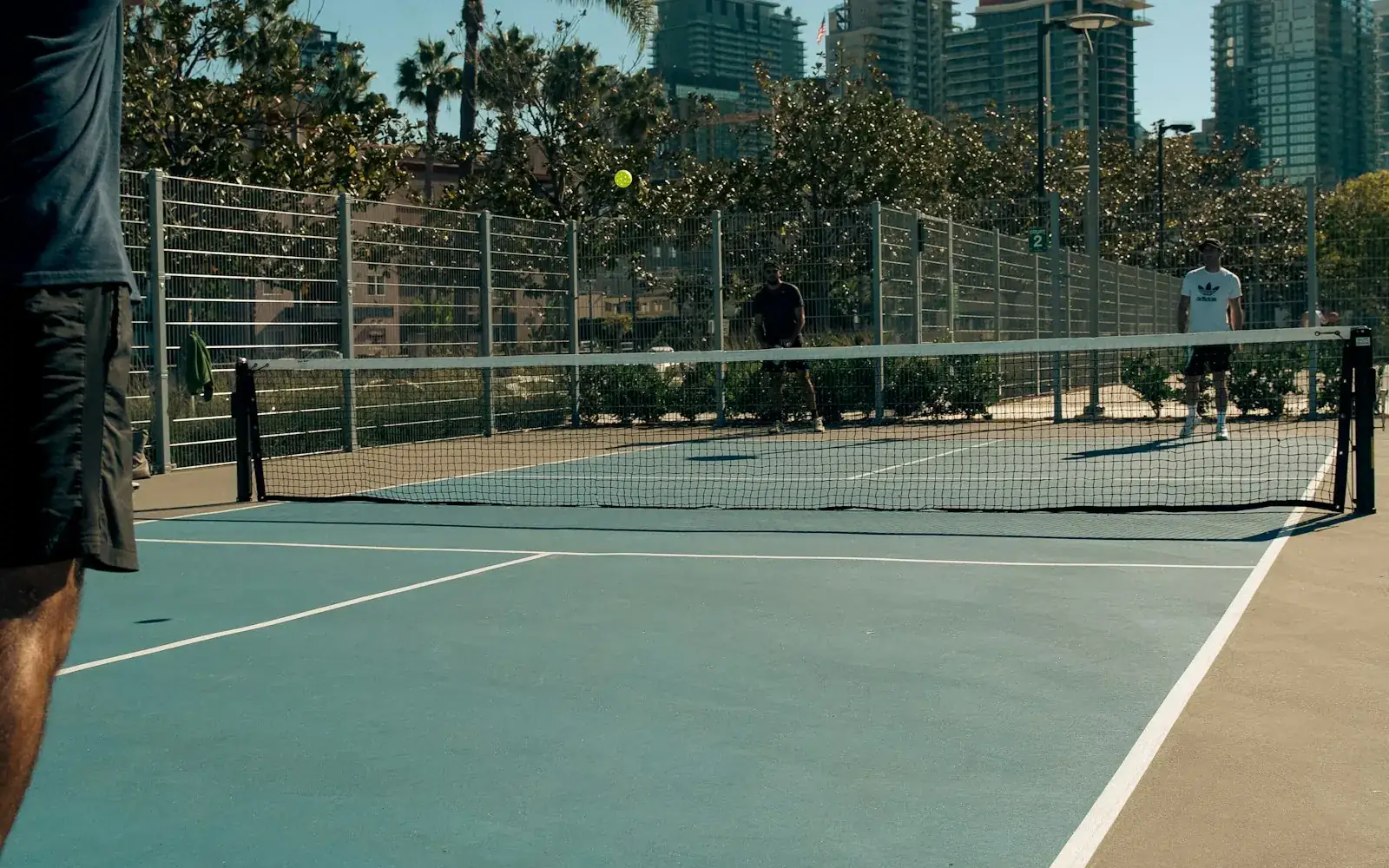
The core idea: imagine an eight-foot rope tying you to your partner. Whatever you do, they mirror. Both up at the net, both back at the baseline, both shifted left, both shifted right. The rope never stretches and never goes slack.
Up and back together
The most common doubles mistake is one player at the net and one at the baseline. It opens a diagonal lane straight through the middle and lets opponents pick you apart. If your partner is stuck back after a weak shot, you come back too until you can both move up behind a drop. One-up-one-back is a losing shape; only use it deliberately, briefly, when one player is resetting under pressure.
Shift with the ball
When the ball is on the left sideline, both of you slide left — the left player covers the line, the right player covers the middle. The far sideline is left open on purpose, because a cross-court pass to the open sideline is the lowest-percentage shot for your opponent. When the ball crosses, you both slide back the other way. You are always shading toward the ball.
The middle is yours to sort out
A ball down the middle should be taken by the player whose forehand is there, or by the player who last hit if there is any doubt. Call it — "mine," "yours," "switch" — every time, out loud, so you are not both watching it land between you. Middle balls that fall untouched are almost always a communication failure, not a skill one.
Stacking, briefly
Advanced pairs "stack" — both line up on the same side before the serve or return, then cross, so a lefty-righty team can keep both forehands in the middle. It is worth learning once your positioning basics are solid; before that, it just adds confusion.
Practising the movement
Book a playing court with your regular partner and play a few games thinking about nothing but the rope. It feels slow and mechanical at first, then it becomes invisible. Positioning wins more club games than any single shot.
Put it into practice on court.
Book a CourtMore in Learn Pickleball
- Pickleball ratings explained: 2.0 to 5.0 and DUPR
- How to return serve — and why it decides the point
- Dinking strategy: winning the soft game